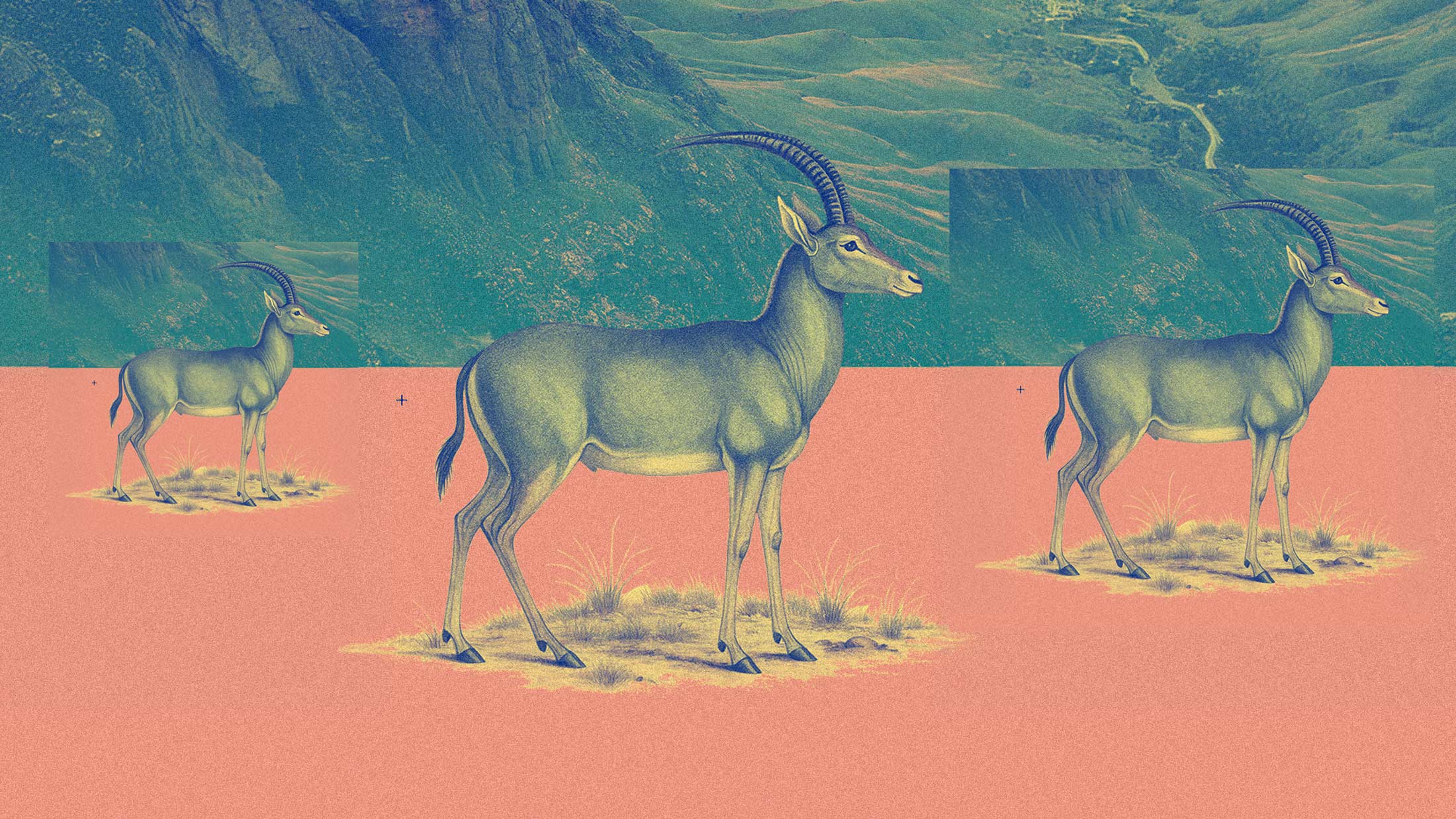
Colossal Biosciences, the Dallas-based company that claims to have de-extincted the dire wolf last year, has announced its next target: the bluebuck, a silvery-blue antelope that vanished from South Africa more than two centuries ago.
"Today we're announcing the bluebuck de-extinction project," the company posted on social media. "Gone since 1800, this silvery, slate-blue grazer once shaped South Africa's grasslands. Now it's on its way back."
The bluebuck holds a grim distinction as the first large African mammal to go extinct in recorded history. European colonizers hunted it avidly despite its meat being considered unpalatable, while simultaneously converting its grassland habitat to farmland. By 1800, the species was gone. Only four mounted specimens survive in museums in Leiden, Stockholm, Vienna, and Paris.
How They Plan to Do It
Colossal's approach mirrors its earlier work with the dire wolf. Researchers obtained tissue samples from the Swedish Museum of Natural History and performed 40-fold genome sequencing to ensure accuracy. The roan antelope, a close living relative found across sub-Saharan Africa, will serve as both the genetic starting point and surrogate.
The science is not straightforward. While the roan and bluebuck share 97% of their genome, that 3% difference translates to roughly 18 million sequence variants. Colossal's genome engineers have whittled that down to approximately three million variants after filtering out those irrelevant to physical appearance. For the dire wolf, the company made just 20 edits across 14 genes. The bluebuck will require more editing than the dire wolf but less than the company's mammoth project.
"This is a clear example of an extinction that is our fault, and that we have the technology now to reverse," said Beth Shapiro, Colossal's chief science officer.
CEO Ben Lamm anticipates the birth of a specimen "in the coming years" rather than decades. The company is working with the Endangered Wildlife Trust on reintroduction plans within the bluebuck's historic range in Southern Africa.
A Growing Menagerie
The bluebuck is Colossal's first project centered on mainland Africa and its first foray into bovids. The company's portfolio has grown rapidly since its founding in 2021 by Harvard geneticist George Church and entrepreneur Lamm.
In April 2025, Colossal announced the birth of three genetically modified gray wolves engineered with dire wolf traits. The animals, named Romulus, Remus, and Khaleesi, live on a 2,000-acre preserve in Texas. Independent scientists have questioned whether they constitute true de-extinction, but the company maintains the work demonstrates its end-to-end capabilities.
The mammoth project targets a live calf by late 2028. The thylacine, or Tasmanian tiger, has achieved complete genome sequencing. The dodo project made breakthroughs in pigeon primordial germ cell culture, and the company has partnered with filmmaker Peter Jackson on New Zealand's moa.
Pet Cloning Meets Conservation
Colossal's November 2025 acquisition of ViaGen Pets and Equine signals where this technology may be heading. ViaGen, founded in Austin in 2002, has cloned 15 species, including the endangered black-footed ferret and Przewalski's horse. The company offers pet cloning at $50,000 for dogs and cats, $85,000 for horses.
The merger makes strategic sense. ViaGen brings cloning success rates approaching 80% across multiple species, far exceeding published averages of roughly 2%. It holds exclusive licensing from Scotland's Roslin Institute, home of Dolly the sheep. Colossal brings CRISPR gene-editing capabilities and deep ancient DNA expertise.
A March 2025 study in Animals examined 56 species successfully cloned to date. The researchers found that the overwhelming majority did not suffer shortened lifespans or infertility, suggesting cloning can serve as an effective conservation tool. The black-footed ferret and Przewalski's horse programs have demonstrated this in practice. Elizabeth Ann, the first cloned black-footed ferret, was created from cells frozen in the 1980s and is poised to inject genetic diversity into a population descended from just seven founders.
Looking Forward
The trend line is clear. Cloning has moved from livestock to pets to endangered species to extinct ones. ViaGen has biobanked genetic material from more than 40 species, including 22 that are threatened or endangered. Colossal maintains what it calls a "long list" of future targets: Steller's sea cow, the Irish elk, the great auk.
Critics remain. The IUCN has questioned whether Colossal's dire wolf proxies contribute to conservation at all. Some scientists argue that resources would be better spent protecting species still clinging to existence. But Lamm has framed de-extinction work as "free research and development" for conservation, noting that technologies developed for mammoths benefit living elephants.
Colossal is now valued at $10.2 billion and has raised $435 million since launching. Whether the bluebuck returns to South African grasslands within this decade remains uncertain. But the company has built the machinery to try.